
Contact centers generate substantial volumes of customer interaction data every day. Phone calls, chat sessions, emails, and social media exchanges collectively represent a significant repository of information about customer needs, agent performance, and operational effectiveness. Yet many organizations struggle to extract meaningful insights from this data, relying instead on small sample reviews and backward-looking reports that capture only fragments of what actually occurs across their operations.
The gap between available data and actionable intelligence has driven increased interest in contact center analytics software. However, the market includes solutions with widely varying capabilities, and selecting the wrong platform can leave organizations with sophisticated dashboards that fail to deliver operational improvements. Understanding which capabilities genuinely matter—and which represent marketing terminology without substantive function—requires examining how analytics tools actually operate within contact center environments.
What Is Contact Center Analytics Software?
Contact center analytics software encompasses platforms that collect, process, and analyze data from customer interactions to generate operational insights. Unlike basic reporting tools that aggregate volume metrics and average handle times, analytics software examines the content and context of interactions themselves.
Modern contact center analytics platforms typically integrate several analytical approaches:
- Speech analytics converts voice interactions into searchable text and applies natural language processing to identify topics, sentiment, and conversation dynamics
- Customer interaction analytics examines patterns across channels to understand customer journeys and identify friction points
- Performance dashboards visualize metrics in real-time, enabling supervisors to monitor operations and intervene when necessary
- Quality monitoring automation evaluates interactions against defined criteria, extending quality assurance beyond manual sampling
The effectiveness of any contact center analytics solution depends on its ability to translate raw interaction data into insights that supervisors, quality teams, and operational leaders can act upon. A platform that generates comprehensive reports without enabling practical response delivers limited value regardless of its analytical sophistication.
Why Do Analytics Capabilities Matter for Contact Center Operations?
Traditional contact center quality monitoring approaches evaluate only 1-3% of customer interactions. This sampling limitation creates blind spots that affect performance assessment, compliance verification, and customer experience optimization. Organizations cannot systematically identify problems they cannot observe, and random sampling may miss patterns that affect significant portions of customer interactions.
Contact center speech analytics and voice analytics capabilities address this visibility gap by enabling analysis of substantially larger interaction volumes—in many cases, 100% of conversations. This expanded coverage changes the nature of quality assurance from exception-finding to pattern recognition, enabling organizations to identify systemic issues rather than individual incidents.
The operational implications extend beyond quality monitoring. Organizations with comprehensive analytics capabilities can:
- Identify training needs based on documented performance patterns rather than supervisor impressions
- Detect compliance issues before they result in regulatory action or customer complaints
- Understand customer sentiment trends across interaction types and time periods
- Correlate agent behaviors with customer satisfaction outcomes
- Base process improvements on evidence rather than assumptions
Selecting analytics software with appropriate capabilities determines whether organizations can achieve these outcomes or remain constrained by limited visibility into their operations.
7 Critical Capabilities in Contact Center Analytics Software
When evaluating contact center analytics platforms, organizations should assess capabilities across seven functional areas that collectively determine whether the software can deliver operational value.
1. Speech Analytics with Accurate Transcription
Speech analytics forms the foundation of voice channel analysis. The technology converts spoken conversations into text, then applies analytical models to extract insights about topics, sentiment, compliance, and conversation dynamics.
Transcription accuracy directly affects analytical reliability. Systems with transcription error rates above 15-20% produce unreliable keyword detection and sentiment analysis, as misrecognized words distort the analytical output. Organizations should evaluate transcription accuracy across their specific call types, accents, and audio quality conditions rather than relying on vendor-provided accuracy claims derived from optimal test environments.
Effective call center speech analytics capabilities include:
- Speaker separation: Distinguishing agent speech from customer speech to enable channel-specific analysis
- Topic detection: Identifying call reasons and conversation subjects without requiring predefined keyword lists
- Acoustic analysis: Detecting emotional indicators through voice characteristics such as pitch, pace, and volume
- Silence and overtalk detection: Identifying hold times, dead air, and simultaneous speech that affect customer experience
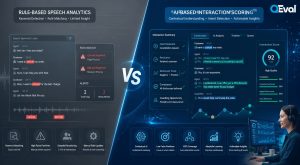
Speech analytics that relies solely on keyword spotting without contextual understanding produces high false-positive rates and misses conversations where customers express concerns using unexpected terminology. More advanced natural language processing approaches that understand semantic meaning deliver more reliable results.
2. Omnichannel Customer Interaction Analytics
Modern contact centers handle customer communications across multiple channels: voice, email, chat, SMS, and social media. Customer interaction analytics must span these channels to provide complete visibility into customer experiences and agent performance.
Single-channel analytics creates blind spots when customers interact across multiple touchpoints. A customer who initiates contact via chat, escalates to phone, and follows up via email represents a single service episode that channel-isolated analysis would treat as three unrelated interactions. Organizations miss opportunities to understand customer effort, identify cross-channel friction, and evaluate overall experience quality.
Effective omnichannel analytics capabilities include:
- Unified interaction records: Connecting related interactions across channels into coherent customer journeys
- Consistent evaluation criteria: Applying comparable quality standards across voice and digital channels
- Cross-channel sentiment tracking: Monitoring customer emotional states as interactions progress across touchpoints
- Channel transition analysis: Identifying where and why customers escalate between channels
Organizations should verify that analytics platforms can ingest data from their specific channel technologies and that analytical models are calibrated for each channel’s characteristics. Text-based analysis for chat interactions requires different approaches than email analysis, and both differ from voice analytics requirements.
3. Real-Time Performance Dashboards
A contact center performance dashboard provides visualization of operational metrics, enabling supervisors and managers to monitor current state and identify emerging issues. The value of dashboard capabilities depends on data currency, visualization design, and integration with operational response mechanisms.
Real-time performance monitoring requires more than displaying recently updated numbers. Effective dashboards incorporate:
- Configurable alerting: Automated notifications when metrics exceed defined thresholds
- Trend visualization: Displaying metric trajectories rather than point-in-time values alone
- Drill-down capability: Enabling users to move from aggregate views to individual interaction details
- Role-based views: Presenting relevant metrics for different user types—agents, supervisors, managers, executives
- Comparative benchmarking: Showing performance against historical averages, targets, and peer groups
Dashboard latency matters for operational responsiveness. Systems that update every 15 minutes provide historical reporting, not real-time visibility. True real-time dashboards reflect current state within seconds or minutes, enabling supervisors to intervene during developing situations rather than analyzing them afterward.
Call center agent performance dashboards should balance comprehensive metrics with usability. Displays overloaded with dozens of indicators become difficult to monitor effectively. Organizations benefit from identifying the five to seven metrics most critical for their operational priorities and ensuring these remain prominent.
4. Automated Quality Monitoring and Scoring
Call center quality monitoring software traditionally required manual evaluation of recorded interactions against defined scorecards. Resource constraints limited coverage to small samples, and evaluator inconsistency introduced variability into quality scores. Automated quality monitoring addresses both limitations.
Effective automated quality capabilities include:
- Customizable evaluation forms: Enabling organizations to define criteria aligned with their quality standards and business requirements
- Weighted scoring: Applying appropriate emphasis to different evaluation criteria based on impact and priority
- Calibration tools: Comparing automated scores against human evaluator assessments to validate accuracy
- Exception flagging: Identifying interactions that require human review due to unusual characteristics or potential compliance issues
- Trend analysis: Tracking quality score patterns over time for individuals, teams, and the organization
Automated scoring should complement rather than replace human quality evaluation. The most effective implementations use automation to identify interactions warranting human attention—whether due to low scores, compliance concerns, or coaching opportunities—while providing consistent baseline evaluation across all interactions.
Organizations implementing automated quality monitoring should establish validation processes that regularly compare automated assessments against human evaluator judgments. Discrepancies indicate areas where automated models require adjustment or where evaluation criteria need clarification.
5. Voice of Customer Analytics
Voice of customer analytics extends beyond operational metrics to capture customer perspectives, preferences, and pain points as expressed during interactions. This capability enables organizations to understand not just what happened during customer contacts but how customers felt about their experiences.
Key voice of customer capabilities include:
- Sentiment analysis: Detecting positive, negative, and neutral emotional indicators throughout interactions
- Customer effort scoring: Identifying indicators of difficulty or frustration in customer communications
- Topic clustering: Grouping interactions by customer-expressed concerns to identify emerging issues
- Competitive mentions: Tracking references to competitors within customer conversations
- Churn indicators: Identifying language patterns associated with customer attrition risk
Voice of customer insights provide value beyond the contact center when shared with product, marketing, and executive teams. Customer feedback about products, services, and policies flows through contact center interactions before appearing in formal surveys or reviews. Organizations that systematically capture and distribute these insights can respond to customer concerns more rapidly than competitors relying on periodic survey data.
6. Integration with Existing Systems
Contact center analytics software operates within a broader technology ecosystem that typically includes telephony platforms, customer relationship management systems, workforce management tools, and quality management applications. Integration capabilities determine whether analytics insights can flow into operational workflows or remain isolated in a separate system.
Critical integration considerations include:
- CRM integration: Connecting interaction analytics with customer records to enable context-aware analysis and support personalized service
- Telephony platform connectivity: Ingesting call recordings and metadata from existing ACD and dialer systems
- Workforce management integration: Correlating quality and performance data with scheduling and adherence information
- API availability: Enabling custom integrations and data exports for organization-specific requirements
- Single sign-on support: Simplifying user access management across connected systems
Organizations should verify integration capabilities with their specific technology stack before selection rather than relying on generic integration claims. A platform that integrates smoothly with one telephony system may require substantial customization to connect with another.
7. Actionable Reporting and Coaching Tools
Analytics capabilities deliver value only when insights translate into operational improvements. Reporting and coaching tools determine whether analysis results reach the people who can act on them and whether those individuals have sufficient context to take appropriate action.
Effective reporting capabilities include:
- Scheduled report distribution: Automatically delivering relevant metrics to stakeholders at appropriate intervals
- Ad hoc query capability: Enabling users to explore data beyond predefined report structures
- Comparative analysis: Facilitating performance comparisons across time periods, teams, and locations
- Export functionality: Supporting data extraction for external analysis and presentation
Coaching tools connect analytics insights to agent development:
- Interaction examples: Providing specific call recordings that demonstrate identified improvement opportunities
- Coaching session documentation: Recording coaching activities and tracking follow-up actions
- Progress tracking: Monitoring agent performance changes following coaching interventions
- Best practice identification: Surfacing examples of effective handling for training and reference
The connection between analytics and coaching represents a critical success factor. Organizations that generate comprehensive analytics without systematic processes for translating insights into coaching activities fail to realize the performance improvements that analytics capabilities enable.
How Should Organizations Evaluate Contact Center Analytics Software?
Selecting contact center analytics software requires evaluation beyond feature checklists. Organizations should assess how capabilities function within their specific operational context.
Conduct Proof of Concept Testing
Vendor demonstrations using curated examples may not reflect performance with actual customer interactions. Organizations should request proof of concept deployments using their own call recordings and interaction data to evaluate accuracy and relevance of analytical outputs.
Assess Implementation Requirements
Understanding the resources required for successful deployment helps set realistic expectations. Organizations should clarify:
- Integration effort with existing systems
- Configuration and customization requirements
- Training needs for different user groups
- Ongoing administration and maintenance responsibilities
- Timeline from contract signing to operational deployment
Verify Scalability and Performance
Analytics platforms must handle current interaction volumes while accommodating growth. Organizations should understand how the platform performs under peak load conditions and what capacity limitations may require future upgrades or additional costs.
Evaluate Vendor Support and Partnership
Successful analytics implementations require ongoing vendor engagement. Organizations should assess support responsiveness, professional services availability, and the vendor’s track record with similar deployments. References from organizations with comparable size and complexity provide valuable perspective on implementation experience and ongoing partnership quality.
Building an Analytics-Driven Contact Center Culture
Technology capabilities alone do not determine analytics success. Organizations must develop processes, skills, and cultural practices that enable effective use of analytical insights.
- Establish clear ownership and accountability. Analytics programs require designated responsibility for monitoring insights, initiating response actions, and measuring outcomes. Without clear ownership, analytical outputs may generate awareness without driving action.
- Develop analytical skills across user groups. Supervisors, quality teams, and managers need training on interpreting analytical outputs and translating insights into operational decisions. Technical proficiency with the analytics platform represents only part of the required competency.
- Create feedback loops between analytics and operations. Regular review cycles should examine analytical findings, assess response effectiveness, and refine analytical focus based on operational priorities. Static analytics programs that continue monitoring the same metrics without adjustment fail to capture evolving needs.
- Balance accountability with development. Analytics that function primarily as surveillance tools create agent resistance and undermine engagement. Effective programs position analytics as development resources that help agents improve while maintaining appropriate performance accountability.
From Analytics to Operational Excellence
Contact center analytics software provides capabilities that can substantially improve operational visibility, quality assurance coverage, and performance management effectiveness. However, realizing these benefits requires selecting platforms with appropriate capabilities for organizational needs, implementing them thoughtfully, and developing the practices necessary to act on analytical insights.
The seven capabilities outlined—speech analytics, omnichannel interaction analysis, real-time dashboards, automated quality monitoring, voice of customer analytics, system integration, and actionable reporting—represent the functional areas most critical for operational impact. Organizations that prioritize these capabilities during evaluation position themselves to move beyond data collection toward genuine analytical intelligence that drives measurable improvements.
Success depends on matching platform capabilities to organizational requirements, investing in implementation and adoption, and maintaining focus on translating insights into action. Contact centers that achieve this alignment transform analytics from a reporting function into a foundation for continuous operational improvement.
Ready to evaluate contact center analytics capabilities for your organization?
Contact us today for a free QEval® demo and discover how comprehensive analytics can provide the visibility and insights your contact center needs to drive measurable performance improvements.