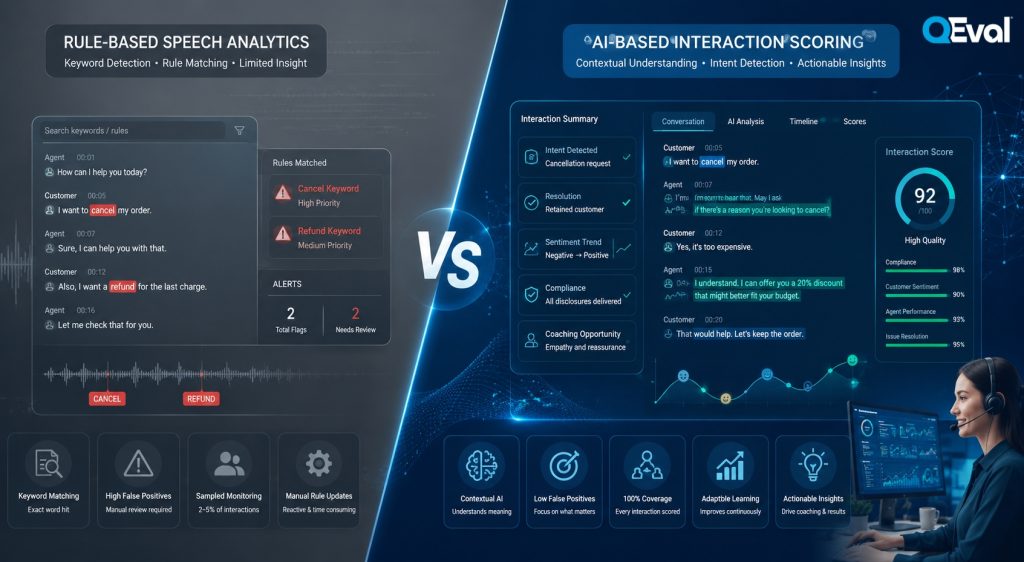
Most quality teams running contact center operations today rely on speech analytics built around keyword detection. The technology has been available for over two decades, and many of the rule sets in use today were configured during initial deployment and have not been substantially revised since. Many contact centers continue to operate on keyword-based or rules-driven monitoring systems. Meanwhile, the industry standard for QA sampling remains at 2 to 5 percent of total interaction volume reviewed by human evaluators, meaning a large portion of customer conversations go without any quality assessment.
The result is a structural gap between what contact center leaders believe they know about interaction quality and what is actually happening across the full range of customer conversations. This guide explains how rule-based speech analytics works, where it falls short, and how AI-based interaction scoring addresses those gaps in practice.
Quick reference guide
Looking for a specific comparison? Jump to the section most relevant to your situation:
- How rule-based speech analytics works → Understanding the two approaches
- Why keyword detection produces false positives → Key limitations of rule-based systems
- How contextual AI scoring works → How AI-based interaction scoring works differently
- Side-by-side capability comparison → Key differences at a glance
- Industry-specific applications → Applications by vertical
- Business case and ROI data → ROI and business impact
- Common questions answered → Frequently asked questions
Understanding the two approaches
What is rule-based speech analytics?
Rule-based speech analytics converts spoken interactions to text and evaluates transcripts against a library of predefined keywords, phrases, and conditional logic sequences. The detection logic is deterministic: the system evaluates each interaction against conditions set by a human administrator and generates flags or alerts based on whether specific patterns appear.
The approach does exactly what its rules specify, no more. Every alert corresponds to a rule that someone wrote at some point during setup. Every gap in detection corresponds to a pattern that was never anticipated or added to the rule library.
What is AI-based interaction scoring?
AI-based interaction scoring uses machine learning models trained on large volumes of real-world contact center interactions to evaluate calls, chats, and digital interactions in context. Rather than matching patterns, the model infers meaning from the full conversation, accounting for what was said, how it was phrased, in what sequence, and what the conversational dynamic suggests about compliance, quality, and agent behavior.
The system produces scored assessments of each interaction, weighted by risk and coaching relevance, rather than binary flags generated by rule matches.
The business case for moving beyond keyword detection
Contact center quality leaders consistently cite compliance detection gaps as a primary risk in programs relying on keyword-based monitoring. Organizations that move from keyword-based monitoring to AI-based full-coverage scoring report:
- Quality score improvements: 20 to 35 points in active programs
- QA effort reduction: Roughly 40% reduction, with supervisor time redirected from alert clearing to active coaching
- Compliance detection rates: Substantially higher than those achieved through rule-based sampling, because coverage extends to 100% of interactions rather than a sampled subset
Key limitations of rule-based speech analytics
1. False positive accumulation
Rule-based systems flag interactions based on word presence, not meaning. An agent who says, “I understand you would like to cancel. Let me find a retention option that might work for you,” is managing the situation correctly. A rule flagging the word “cancel” does not distinguish this from a mishandled cancellation request. Quality teams in high-volume environments report that 50 to 70 percent of rule-based flags require manual review and clearing before any actionable insight surfaces. The time spent on that clearing is QA capacity that does not go toward coaching.
2. False negative exposure
False negatives are the failure mode rule-based systems create but rarely surface on their own. When a compliance issue occurs in language the rules do not cover, such as a policy deviation phrased in colloquial terms or a misleading statement using vocabulary outside the flagged library, the interaction passes through unmarked. In regulated industries, this creates audit exposure that organizations often do not discover until after an external review.
3. Context blindness
Keyword detection evaluates words in isolation. It cannot assess the structure of a conversation, the order in which disclosures were delivered, whether an agent’s tone suggested hesitation during a compliance statement, or whether a customer’s sentiment trajectory indicated escalation risk. These contextual signals are invisible to rules-based logic.
4. Rule maintenance overhead
Every change in regulatory requirements, product information, scripting standards, or competitive environment requires manual rule updates. In practice, this work is reactive: rule sets tend to be updated after incidents surface through audits or complaints, not proactively as conditions change. Organizations operating in active compliance environments may require dozens of rule set revisions per year, each consuming QA analyst time that could go toward direct performance improvement work.
5. Coverage constrained by sampling
Rule-based monitoring has historically been applied to a fraction of interaction volume because the system generates flags that require human review. Reviewing 100% of flagged interactions from 100% of volume is not operationally feasible with this approach. Quality assessment is structurally limited to the interactions the system was configured to catch, applied to the percentage of volume that humans can process downstream.
How AI-based interaction scoring works differently
1. Contextual validation reduces false positives
AI scoring models evaluate the meaning of a statement within the full conversation, not the presence of a word. An agent using the word “cancel” in a retention context scores differently from an agent who mishandles the same topic. This contextual distinction reduces the volume of flags requiring manual clearing and directs QA effort toward interactions that actually warrant attention.
2. Intent-based detection closes the false negative gap
Because the model infers meaning from conversation structure rather than vocabulary lists, it detects compliance risk expressed in paraphrased or colloquial language. A disclosure delivered in misleading framing registers as a risk signal even when none of the flagged keywords appear in the transcript. This closes the false negative exposure that rule-based monitoring cannot address by design.
3. Full conversation analysis
AI scoring evaluates the full arc of an interaction: topic progression, sentiment shifts, agent behavior patterns, customer escalation signals, disclosure sequencing, and conversational resolution. The quality score reflects what actually happened across the interaction, not whether specific words appeared at specific points.
4. Model adaptation without manual rule updates
AI scoring models adapt as interaction patterns evolve. When new regulatory language, product terminology, or customer behavior patterns emerge in the data, the model updates without requiring a human to rewrite rule logic. This reduces the reactive maintenance burden and makes the system more durable as the operating environment changes.
5. 100% interaction coverage with prioritized output
AI-based systems are designed to process every interaction. Rather than generating raw alert queues, the model produces risk-ranked lists: which interactions most warrant supervisor attention, which agent behaviors are recurring across multiple calls, which compliance patterns are trending. A quality team reviewing 30 interactions per week using a priority list generated by AI scoring reviews the 30 most important ones, not 30 drawn from a queue of uncertain accuracy.
Key differences at a glance
| Dimension | Rule-based speech analytics | AI-based interaction scoring |
| Detection logic | Keyword and phrase matching | Model inference from full conversation context |
| False positive rate | High when rule sets are broad | Lower due to contextual evaluation |
| False negative exposure | High for novel or paraphrased issues | Substantially reduced by intent-based detection |
| Adaptation | Manual rule updates required | Model adapts continuously with new interaction data |
| Output | Alert queues requiring manual review | Risk-ranked interaction lists with coaching priorities |
| Interaction coverage | Selective — applied to a subset of volume | Designed for 100% of interactions |
| Compliance detection | Vocabulary-dependent | Intent and context-sensitive |
| Calibration consistency | Variable across individual reviewers | Consistent across all scored interactions |
| Maintenance overhead | Requires ongoing rule set revisions | No manual rule maintenance required |
Applications by vertical
Healthcare
Healthcare contact centers handle patient inquiries, appointment management, and billing under HIPAA and related regulatory frameworks. Rule-based monitoring applied to 3% of calls leaves 97% of patient interactions unreviewed. AI scoring across 100% of interaction volume identifies disclosure compliance issues, patient escalation risk, and documentation accuracy gaps that sampling approaches miss. Privacy adherence verification becomes continuous rather than sampled, supporting audit preparedness across the full interaction record.
- Compliance score target: 98%+ required
- CSAT benchmark: 85 to 90%
- Coverage gap with rule-based sampling: Up to 97% of interactions unscored
Financial services and insurance
In financial services and insurance, regulatory exposure from missed disclosure or misleading product explanation compounds over time. Rule-based keyword detection applied to selected call types may miss policy violations that occur in standard advisory conversations. AI scoring evaluates every interaction for disclosure sequencing, compliance language completeness, and customer understanding signals, producing compliance documentation across full interaction volume rather than a sampled subset.
- Security compliance target: 100%
- FCR benchmark: 70 to 75%
- Primary risk: Regulatory exposure from false negatives in sampled monitoring
Telecommunications
Telecom contact centers manage high interaction volumes across billing, technical support, and service retention. False positives in retention and cancellation queues represent significant QA overhead under rule-based monitoring. AI scoring distinguishes correctly handled cancellation conversations from mishandled ones, reducing time QA teams spend clearing flags and increasing time available for targeted agent coaching on interactions that genuinely need it.
- Technical resolution rate target: 85%+
- Customer retention rate target: 90%+
- Primary QA challenge: False positive volume from keyword-based retention monitoring
Implementation considerations
Moving from rule-based monitoring to AI-based interaction scoring does not require replacing existing contact center infrastructure. AI scoring platforms ingest interaction data from existing telephony, CCaaS, and recording systems.
Deployment timeline
Standard deployment runs approximately 30 days, including data integration, model configuration, scoring calibration, and QA team onboarding. Most programs reach consistent operational adoption within 60 days of go-live.
Transition approach
Organizations do not need to decommission rule-based systems immediately. Running AI scoring alongside existing keyword monitoring during an initial period allows quality teams to compare what each approach surfaces directly, building confidence in the AI output before shifting the primary review workflow.
Calibration
AI scoring models are calibrated to organizational scoring standards and compliance requirements during implementation. Calibration sessions in the first 30 to 60 days align model outputs with internal QA criteria, reducing scoring disputes and accelerating adoption among frontline quality teams. Programs typically reach 90-plus percent adoption within 60 days of go-live.
Phase overview
- Phase 1 (Days 1 to 30): Data integration, model configuration, and initial calibration against scoring criteria
- Phase 2 (Days 31 to 60): QA team onboarding, parallel running with existing system, calibration refinement
- Phase 3 (Days 61 to 90): Full operational adoption, priority-list coaching workflow, compliance reporting live
ROI and business impact
Contact center programs that transition from rule-based monitoring to full-coverage AI scoring document the following outcomes:
Quality performance
- Quality score improvement: 20 to 35 points across comparable measurement periods
- Calibration session duration: Reduced by approximately 30 to 50%, as model consistency reduces scoring disagreements between reviewers
Operational efficiency
- QA effort reduction: Roughly 40% reduction in total QA effort as alert clearing decreases
- Supervisor time reallocation: From queue management to actionable performance development
- FCR improvement: 10 to 15% improvement as coaching targets the interactions most likely to recur
Compliance
- Interaction coverage: 100% versus the 2 to 5% industry standard for human-reviewed sampling
- Compliance event detection: In interactions that would not have been selected under sampling approaches
- Audit documentation: Audit-ready scoring records across full interaction volume, not a sampled subset
Frequently asked questions
What is the difference between speech analytics and interaction scoring?
Speech analytics is a broad category of technology that analyzes spoken or written customer interactions, typically including transcription, keyword detection, and sentiment signals. Interaction scoring refers specifically to the systematic evaluation of interactions against quality and compliance criteria. AI-based interaction scoring applies machine learning models to score 100% of interactions in context, rather than flagging based on keyword rules applied to a sampled percentage of volume.
Can AI scoring work alongside existing speech analytics platforms?
Yes. AI-based interaction scoring integrates with most existing contact center platforms, including CCaaS providers and legacy recording systems. Organizations typically deploy AI scoring as an evaluation layer over their existing technology stack rather than as a direct replacement, particularly during an initial transition period.
How long does it take to deploy AI-based interaction scoring?
Standard deployment takes approximately 30 days, covering data integration, model configuration, and initial calibration against the organization’s scoring criteria. Most programs reach 90-plus percent adoption among QA teams within 60 days of go-live.
How does AI scoring handle language variation and accents?
AI scoring models trained on large, diverse interaction datasets handle language variation, accents, and colloquial phrasing more consistently than keyword-based rules, which require separate configuration for each language variant and phrasing pattern. Multilingual deployments require model configuration specific to each supported language.
What percentage of interactions does AI scoring review?
AI-based scoring systems are designed for 100% interaction coverage. This contrasts with the 2 to 5% QA sampling rate that remains the industry standard for human-reviewed monitoring. Processing every interaction allows the scoring model to identify patterns and issues that selective sampling approaches are structurally unable to surface.
How does AI scoring improve compliance monitoring?
Rule-based systems detect compliance issues only when specific flagged vocabulary appears. AI scoring evaluates disclosure completeness, procedural adherence, and statement intent across every interaction, detecting compliance risk in paraphrased or contextually ambiguous language that keyword rules do not flag.
What happens when compliance requirements change?
Rule-based systems require manual rule updates when compliance requirements change, creating a reactive gap between the regulatory environment and what the monitoring system can detect. AI scoring models adapt as the interaction data they process reflects new patterns and requirements, reducing the maintenance burden that accompanies regulatory or policy changes.
What is the ROI timeline for implementing AI-based interaction scoring?
Programs typically see measurable quality score improvements within the first 60 to 90 days of full deployment, as coaching conversations shift from managing alert queues to addressing the interactions the model identifies as most impactful. Compliance detection improvements are visible from the first week of full coverage, since the system immediately surfaces interactions that sampling approaches would not have selected.
What this means for your QA program
The choice between rule-based speech analytics and AI-based interaction scoring is fundamentally a decision about what your quality program can see. Rule-based monitoring reports on which keywords appeared. AI scoring reports on what happened, across every interaction your contact center handles.
For quality teams managing compliance risk in regulated industries, the coverage gap is material. For operations leaders evaluating QA efficiency, the false positive overhead in keyword-based systems represents a direct and measurable cost. For supervisors trying to coach agents effectively, the difference between a raw alert queue and a priority-ranked coaching list determines how their available capacity gets used.
QEval™ applies contextual AI scoring across 100% of contact center interactions, producing prioritized coaching lists, compliance event alerts, and quality trend reporting without manual rule maintenance. Standard deployment takes approximately 30 days.