Most QA programs look functional on a scorecard. Reports go out on schedule. Quality scores move in the right direction. Calibration sessions happen monthly. And still, agents repeat the same mistakes, compliance events slip through, and customers end calls frustrated in ways that never appear in any report.
That’s not a people problem. It’s a sampling problem. And if your contact center quality monitoring program runs on a 2-5% sample of interactions, the blind spots are structural, not incidental.
The math your QA program is quietly hiding
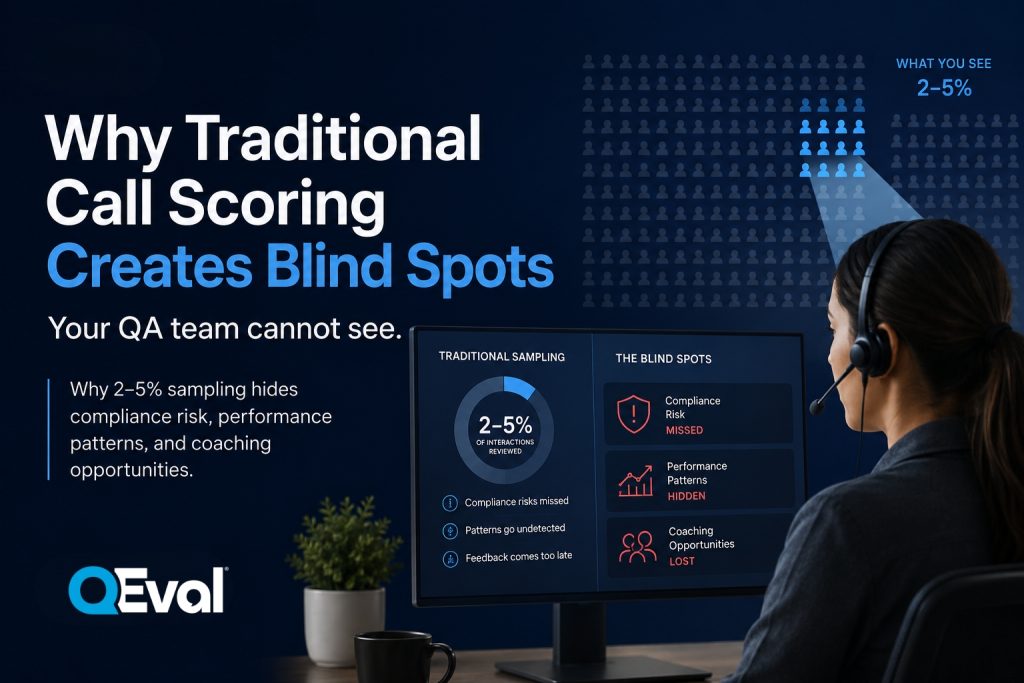
Traditional call center quality monitoring is built on a sample. Industry practice puts that sample between 2 and 5 percent of total call volume. In practical terms, a contact center handling 10,000 interactions per week reviews somewhere between 200 and 500 of them.
The other 9,500 to 9,800 interactions? They happened. Agents handled them. Customers reached a resolution or they didn’t. Compliance requirements were met or they weren’t. Your program simply has no visibility into which.
When 95 out of every 100 interactions go unreviewed, the quality picture you’re building is incomplete by design, not because of how your analysts work, but because of how the program was built.
That distinction matters. The blind spots aren’t a failure of your QA team. They’re a structural feature of sample-based call center quality monitoring that most programs were never designed to address.
Where the blind spots actually appear
Sampling creates three specific gaps that compound over time.
Compliance risk that doesn’t cluster. If a compliance issue appears in one out of every 50 calls, a 5% sample catches it roughly once in ten weeks of consistent review. Low-frequency, high-risk events are precisely the ones traditional QA misses most often. They’re also the ones that create regulatory exposure before anyone realizes there’s a pattern.
Performance patterns that only show at scale. One agent using incorrect fee language on a single call looks like an isolated error. The same language appearing across 30 calls from 12 agents over three weeks looks like a training gap or a script problem. That pattern is invisible in a 2-5% sample. It surfaces immediately when you’re reviewing every interaction.
Coaching feedback that arrives too late. Call center quality monitoring works best when feedback follows behavior closely. When a QA analyst scores a call five to seven days after it happened, the agent has handled dozens of other interactions since then. The behavioral connection weakens. The coaching opportunity expires before it gets used.
Why random sampling isn’t actually random
Here’s a detail that rarely gets examined in contact center quality assurance programs: the calls selected for review are rarely random in the statistical sense. QA teams prioritize calls flagged through escalation queues, supervisor observations, or customer complaints.
That selection process means your scoring dataset skews toward confirmed problems. You’re measuring calls you already had reason to examine, not the full population of what agents do on an average day.
The result is a quality program that confirms what you already know and misses what you don’t. It measures the surface of performance, not the depth of it.
What selective scoring does to agent trust
There’s a cost to sample-based quality monitoring that doesn’t appear in any metric: what it does to how agents experience the QA process.
When scoring is infrequent and selection feels arbitrary, agents experience review as unpredictable. They don’t know which calls get scored, or why. They can’t calibrate their behavior against consistent feedback because the feedback doesn’t come consistently.
A single critical review, delivered on a call the agent considered routine, can feel punitive even when it’s intended as development. QA becomes something that happens to agents rather than something that supports them. That dynamic erodes trust in the process and makes it harder for genuine coaching to land.
Full-coverage programs change this dynamic. When every interaction is reviewed against a consistent standard, the process becomes predictable. Agents understand what’s expected because they see it applied evenly, not selectively. That consistency is what separates a QA program that improves performance from one that only evaluates it.
How to recognize if your QA program has blind spots
Ask these questions about your current contact center quality monitoring approach:
What percentage of your weekly interactions does your team score? If the answer is below 10%, your coverage gap is significant enough to affect your data reliability.
How are calls selected for review? If selection involves escalation queues or supervisor nominations, your sample skews toward known problems rather than representing typical performance.
How quickly does feedback reach agents after a scored call? If the lag exceeds 48 to 72 hours consistently, the coaching window closes before agents can connect the feedback to specific behavior.
Can you identify a compliance event before it appears in a customer complaint or regulatory flag? If your current QA process is reactive rather than predictive, the sample size is a contributing factor.
These aren’t abstract questions. Each one points to a specific operational gap that sampling creates and that full interaction coverage addresses directly.
What 100% interaction coverage changes
Moving from a 2-5% sample to full coverage doesn’t simply mean reviewing more calls. It changes what your QA program can structurally do.
Compliance events surface before they compound into regulatory exposure. Performance patterns become visible across the full agent population. Coaching becomes grounded in a complete picture of what each agent actually does across their entire workload, not a small slice of it.
Programs that operate at full interaction coverage report 20 to 35 point lifts in quality scores and roughly 40 percent reductions in QA effort. That reduction happens because analysts spend their time on meaningful review and coaching, not on call selection logistics and administrative scoring. The work shifts from managing the sample to acting on the signal.
The question worth sitting with: when your QA program reports a quality score, does that number represent the quality of the calls that got reviewed, or the quality of everything happening on your contact center floor? Those are different questions with different implications.
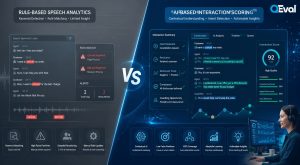
Traditional call scoring was built to answer ‘were these specific calls acceptable?’ Full coverage is built to answer ‘how is my entire operation performing?’ Recognizing that difference is the first step toward closing the gap.
See what your QA program is missing
QEval™ analyzes 100% of customer interactions and surfaces the compliance events, performance patterns, and coaching opportunities that traditional call center quality monitoring cannot reach.
Talk to the QEval™ team to see what full interaction coverage looks like for your contact center.